Strategic Backing by the US Government

Strategic Backing by the US Government

Strategic Backing by the US Government
Low-Cost Solution Mining With Low OPEX

Low-Cost Solution Mining

Low-Cost Solution Mining With Low OPEX
Strategically Located to Key Markets

Strategically Located to Key Markets

Strategically Located to Key Markets

Defining Africa's Next

Major Potash Resource

Defining Africa's Next Major Potash Resource

a couple of people standing in a field next to a couple of large green farm
structural shot of wind mills during daytime

Rising Demand, Limited Supply, Strategic Opportunity

Global food demand is rising fast as the population nears 10 billion, while potash supply remains concentrated and constrained. With the market set to grow from $62B to nearly $100B by 2034, limited new production and rising fertilizer prices create a strong, long-term investment opportunity

Rising Demand

By 2050, global food production must increase by 50% to feed 9.7 billion people, driving long-term potash demand.

Rising Demand

By 2050, global food production must increase by 50% to feed 9.7 billion people, driving long-term potash demand.

Critical Mineral for the US

Potash was added to the U.S. List of Critical Minerals in November 2025 for its importance to economic and national security.

Backed by US Govt

Potash was added to the U.S. List of Critical Minerals in November 2025 for its importance to economic and national security.

Depleting Soils

Over 95% of global farmland is losing nutrients faster than they’re replaced, making potash vital to sustain productivity.

Depleting Soils

Over 95% of global farmland is losing nutrients faster than they’re replaced, making potash vital to sustain productivity.

structural shot of wind mills during daytime

Rising Demand, Limited Supply, Strategic Opportunity

Global food demand is rising fast as the population nears 10 billion, while potash supply remains concentrated and constrained. With the market set to grow from $62B to nearly $100B by 2034, limited new production and rising fertilizer prices create a strong, long-term investment opportunity

Rising Demand

By 2050, global food production must increase by 50% to feed 9.7 billion people, driving long-term potash demand.

Critical Mineral for the US

Potash was added to the U.S. List of Critical Minerals in November 2025 for its importance to economic and national security.

Depleting Soils

Over 95% of global farmland is losing nutrients faster than they’re replaced, making potash vital to sustain productivity.

A Critical Resource for Food and Security

Recognizing its economic and national security importance, the U.S. Department of the Interior added potash to its final 2025 List of Critical Minerals in November 2025.

This designation acknowledges the high import reliance and the potential for supply chain disruptions to significantly impact the U.S. economy, particularly the agricultural sector.

Inclusion on the list can support faster permitting for domestic projects, encourage investment in U.S. production and raise potash's profile in strategic resource planning.

1
1
Irreplaceable for Global Food Production

Potash is vital for healthy crop growth and higher yields. With no substitute, it is essential to global food security.

2
2
Concentrated in Few Global Sources

Most potash comes from a handful of countries, creating dependence on limited and sometimes unstable supply.

3
3
Exposed to Geopolitical Instability

Conflicts and trade restrictions disrupt supply chains, making secure and diversified sources more important.

4
4
Critical to Economic and Food Stability

Supply disruptions impact crop yields, food prices, and economies worldwide, underscoring potash’s role in long-term stability

A Top-Performing TSXV Company

We’re proud to share that Millennial Potash has been named to the 2026 TSX Venture 50, a flagship TSXV program celebrating standout market performance among listed companies.

The Banio Potash Project

Strategic West African Advantage

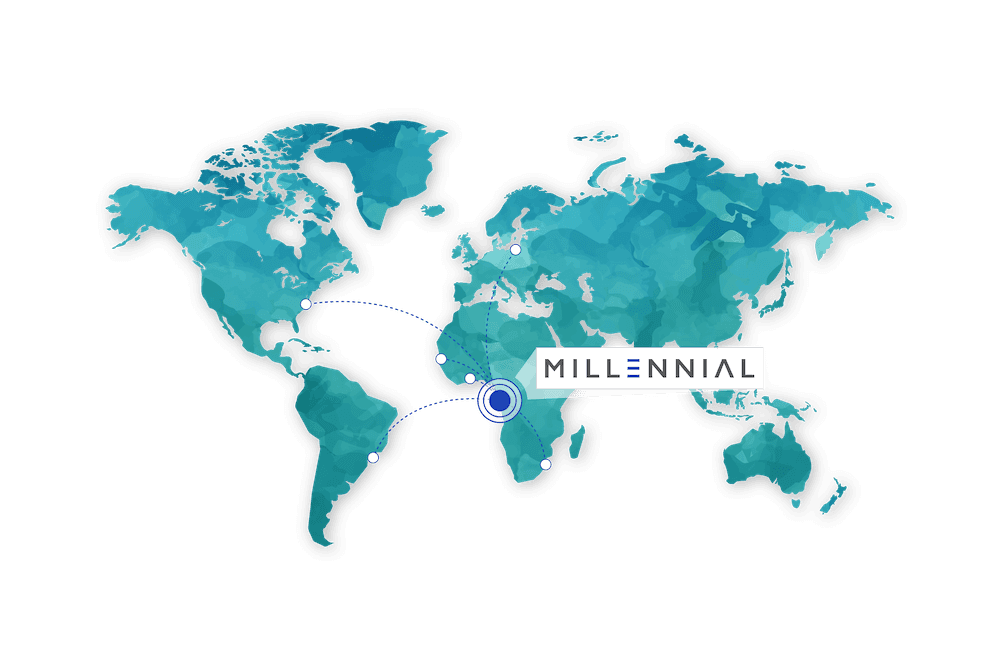
Located on Gabon's Atlantic coast, with deep-water port infrastructure under development nearby, the Banio Project combines large potash mineral resources with favourable logistics.

The project is supported by U.S. development funding and government infrastructure investment. The April 2024 PEA indicates the potential for low operating and transport costs to Brazil, the U.S. and Asia.

The project is ideally suited for solution mining and modular development, offering flexibility and lower upfront costs. Led by a management team with a proven record of building and exiting billion-dollar resource companies, the Banio project creates a unique opportunity in a tightening market.
A Growing Potash Resource

The 2025 Mineral Resource Estimate increased Measured and Indicated Mineral Resources by approximately 275% to 2.45 billion tonnes grading 15.6% KCl, and Inferred Mineral Resources by approximately 210% to 3.56 billion tonnes grading 15.6% KCl. Mineral resources that are not mineral reserves do not have demonstrated economic viability.

Low Projected Operating Costs

The April 2024 PEA estimated operating costs of approximately US$61 per tonne of granular MOP and transport costs to Brazil of approximately US$22 per tonne. The PEA is preliminary in nature and includes Inferred Mineral Resources. There is no certainty that the PEA will be realized.

Backed by the US Government

The U.S. International Development Finance Corporation (DFC) committed up to US$3 million to support the Feasibility Study (FS) for Millennial Potash’s Banio Project.

Backed by the US Government

The U.S. International Development Finance Corporation (DFC) committed up to US$3 million to support the Feasibility Study (FS) for Millennial Potash’s Banio Project.

The Global
Opportunity

~$100 Billion by 2034

USD $62 billion in 2024 and is forecast to reach ~$100 billion by 2034, growing at 4.5–5% CAGR.

~$100 Billion by 2034

USD $62 billion in 2024 and is forecast to reach ~$100 billion by 2034, growing at 4.5–5% CAGR.

~$100 Billion by 2034

USD $62 billion in 2024 and is forecast to reach ~$100 billion by 2034, growing at 4.5–5% CAGR.

65% of Global Supply

Over 65% of global supply comes from just three countries: Canada, Russia, and Belarus.

65% of Global Supply

Over 65% of global supply comes from just three countries: Canada, Russia, and Belarus.

65% of Global Supply

Over 65% of global supply comes from just three countries: Canada, Russia, and Belarus.

Sustainable Food Supply

Investing in sustainable food production aligning with ESG-focused investment strategies.

Sustainable Food Supply

Investing in sustainable food production aligning with ESG-focused investment strategies.

Sustainable Food Supply

Investing in sustainable food production aligning with ESG-focused investment strategies.

Rising Global Food Demand

World population is projected to reach ~9.7 billion by 2050, requiring food production to increase by 50–60%

Rising Global Food Demand

World population is projected to reach ~9.7 billion by 2050, requiring food production to increase by 50–60%

Rising Global Food Demand

World population is projected to reach ~9.7 billion by 2050, requiring food production to increase by 50–60%

You have questions or need more information? Reach out to us!

Whether you have questions about our projects, the investment opportunities, or want to learn more about Millennial Potash: We are here to help.

Reach out to us today and learn more about our approach to becoming a globally significant, low-cost potash producer.

Suite 300 - 1455 Bellevue Avenue
West Vancouver, BC V7T 1C3
Canada

* indicates required

You have questions or need more information? Reach out to us!

Whether you have questions about our projects, the investment opportunities, or want to learn more about Millennial Potash: We are here to help.

Reach out to us today and learn more about our approach to becoming a globally significant, low-cost potash producer.

Suite 300 - 1455 Bellevue Avenue
West Vancouver, BC V7T 1C3
Canada

* indicates required
green rice field

Millennial Potash - At a Glance

Learn more how we are aiming to become a key supplier of fertilizer to Africa, Brazil, the U.S., and Asia, supporting global food security through sustainable, solution-mining development.

green rice field

Millennial Potash - At a Glance

Learn more how we are aiming to become a key supplier of fertilizer to Africa, Brazil, the U.S., and Asia, supporting global food security through sustainable, solution-mining development.

Technical and Cautionary Information

Qualified Person. The scientific and technical information on this website has been reviewed and approved by Peter J. MacLean, Ph.D., P.Geo., a director of the Company and a Qualified Person as defined by National Instrument 43-101. Further details are in the Company’s technical reports filed on SEDAR+ at www.sedarplus.ca.

Mineral Resources. Mineral resources that are not mineral reserves do not have demonstrated economic viability. The Company has not defined any mineral reserves at the Banio Potash Project. The 2025 Mineral Resource Estimate was announced on November 17, 2025 and the supporting technical report was filed on December 29, 2025.

Preliminary Economic Assessment. The April 2024 PEA is preliminary in nature and includes Inferred Mineral Resources that are considered too speculative geologically to have the economic considerations applied to them that would enable them to be categorized as mineral reserves. There is no certainty that the PEA will be realized. The PEA predates the 2025 Mineral Resource Estimate and does not reflect it.

Drilling Results. Drill intervals reported for 2026 are cumulative thicknesses based on preliminary core logging. Assay results are pending.

Forward-Looking Statements. This website contains forward-looking statements, including statements about planned studies, permitting, financing, infrastructure and development. Actual results may differ materially. See the risk factors in the Company’s filings on SEDAR+.

Past Performance and Third-Party Content. Past performance of the Company’s directors, officers and advisors with other companies is not indicative of future results. Third-party articles, interviews and analyst coverage are provided for information only and do not represent the views of the Company.

Reach Us

Suite 300 - 1455 Bellevue Avenue
West Vancouver, BC V7T 1C3
Canada

© 2026 Millennial Potash Corp. | All Rights Reserved